Yasmin and Yaz Birth Control Lawsuits Mount Against Bayer


Dad, 40, Had No Idea He Had 5 Blocked Arteries. A Checkup Prevented A Heart Attack
While on vacation with his wife last year, Peter Sunwoo heard about a healthy acquaintance who had a heart attack at 39 years old. He and a friend had just turned 40, so they decided to get their hearts checked — just in case.
Sunwoo's doctor appointment led to an early discovery of five extremely blocked arteries, and he underwent surgery to repair them before they caused a heart attack. His doctors couldn't point to a specific cause for the blockages, and Sunwoo didn't have any risk factors, so they speculated that it was likely genetic.
"Luckily, I found out just by chance," Sunwoo, 41, of Brooklyn tells TODAY.Com. "I'm an extremely unlucky person for even having this genetic thing, but at the same time, it's being countered with being extremely lucky because my heart is in complete, functional condition."
A check-up reveals an unknown problemFor much of his life, when Sunwoo ran, he felt a tightness in his chest. He thought running was supposed to feel uncomfortable.
"I always thought when you run you would have a chest tightness — that was always a norm for me. I never thought like, 'Oh, this is a symptom,'" Sunwoo says. "I would cycle a lot or swim. ... Running was not my thing."
Then, on a recent cruise with his wife and friends, Sunwoo and his friend thought they should undergo an examination of their heart health, especially because the acquaintance who had a heart attack seemed healthy and fit.
When Sunwoo went for his cardiac stress test, it revealed some abnormalities. Doctors recommended he undergo a CT scan, which showed a high calcium score. According to the American Heart Association, a calcium score gives doctors an understanding of how much calcium is in the arteries. The higher the score, the more severe the blockage is. A cardiologist reinforced the CT findings, locating five blocked arteries.
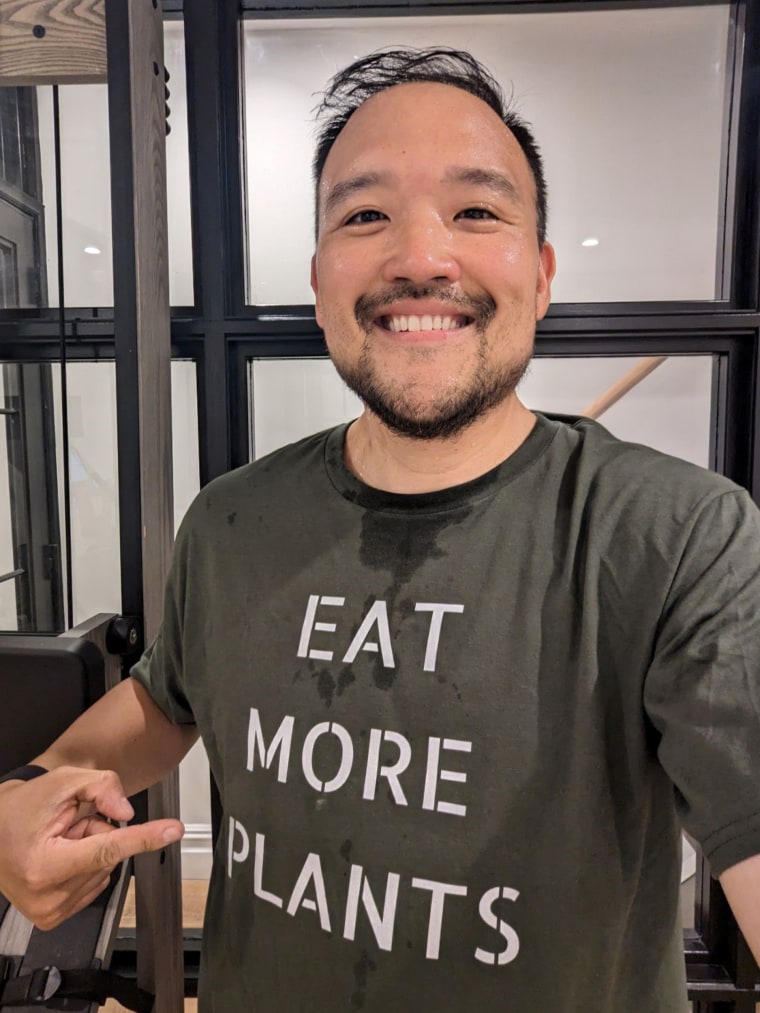 More than a year ago, Peter Sunwoo transitioned to a mostly plant-based diet. He increased the amount he exercised, too, to lose some weight.Courtesy Peter Sunwoo
 "Most people will find out (about blocked arteries) after a heart attack," Sunwoo says.
He says that the severity of his blockages made doctors think that something underlying was going on in his body. He was eating fairly healthy and exercised regularly, recently losing about 50 pounds before his heart problems were discovered.
"It can't be lifestyle is what the doctors (were) saying because there's just nothing you could do to possibly get (a calcium score) that high," he says. "I had no symptoms."
Sunwoo met with Dr. John Puskas, chair of cardiovascular surgery at Mount Sinai Morningside, about bypass surgery. Finding his blocked arteries before a heart attack meant that Sunwoo's heart muscle was still at full capacity, and undergoing a bypass would help keep it that way.
"The way Dr. Puskas has described it is my engine is perfectly fine, but the fuel lines are clogged," he says.
To help clear the blockages, Puskas performed bypass surgery on Sunwoo.
'Blockages are silent until they're not'It's common for people with heart disease to be unaware that something's wrong. Sometimes conditions such as high blood pressure or elevated cholesterol cause no symptoms.
"The blockages are silent until they're not," Puskas tells TODAY.Com. "That sounds silly, but the blockages tend to develop that slowly. They develop because of the deposition of calcium and cholesterol in the walls of the arteries that feed the heart, narrowing the pathway down."
Puskas says CT scans of the heart give doctors a good idea about artery blockage.
"Peter's (calcium) score was 1,789. Normal is anything less than 10. So, 1,789 will put him in the highest top 1% or 2% for his age," Puskas explains. "In fact, he had some damage to the pumping function of his heart even without him being unaware, which is a little unusual."
Doctors aren't exactly sure why Sunwoo experienced such severe blockages as a young age.
"He didn't have a lot of other risk factors," Puskas says. "We're left with a bit of a mystery as to why this particular young man developed these blockages to such an extent in all of the arteries of his heart. When we don't have a good thing to point the finger at, we blame the genes."
Sunwoo's chest pain while running was an early sign of heart troubles, which he did not realize. Still, he visited the doctor before anything catastrophic occurred.
"He came early, and he hadn't suffered a big heart attack, and that's terribly important because bypass surgery prevents another heart attack," Puskas says. "It can't undo a heart attack that's already happened."
Puskas preforms bypass surgery differently than many doctors. A heart bypass surgery involves taking a blood vessel — an artery or vein — from another part of the body and connecting it to the heart so blood can go around the blockage, according to the Mayo Clinic.
Traditional bypass surgery involves the use of a heart-lung machine (which takes over the function of the heart and lungs), a thin tube inserted into the heart, draining the heart of blood, clamping the aorta (the largest artery in the body) and an injection of a high potassium solution to stop the heart. But this type of procedure carries some risks, such as stroke or post-surgery cognitive decline.
Puskas does not use a heart-lung machine, nor does he insert the tube or clamp the aorta. What's more, his blood vessel of choice for a bypass is arteries, not the traditional veins, because arteries are better suited for the high-volume flow of the heart, he says.
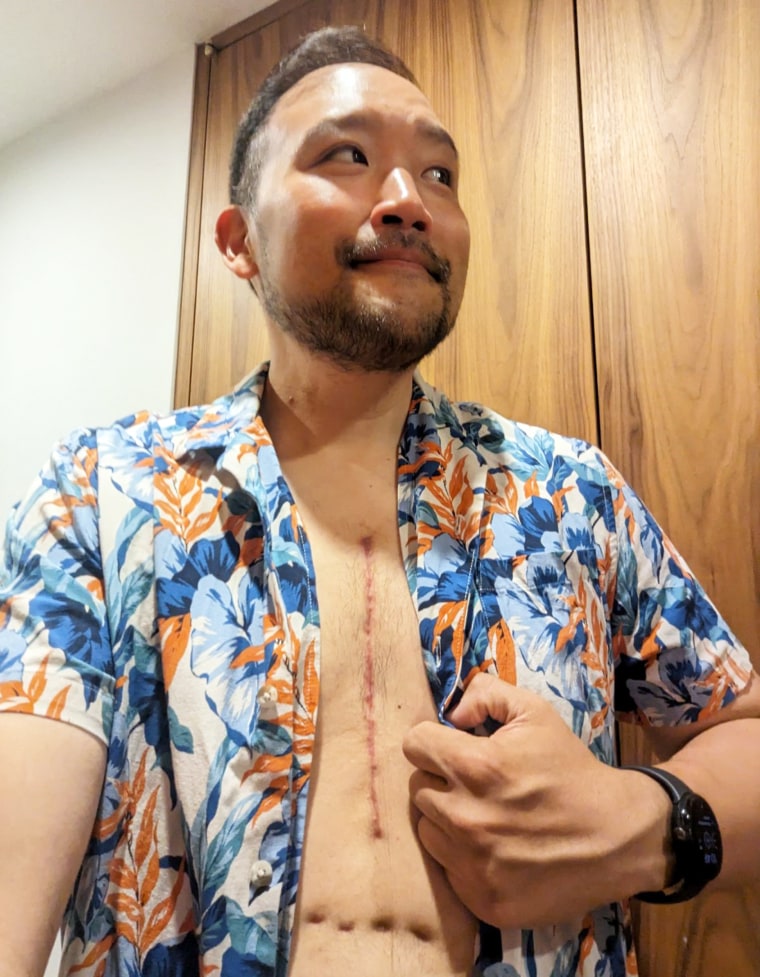 While Peter Sunwoo "bounced back" after bypass surgery, he still had to take things slowly.Courtesy Peter Sunwoo
 Veins "gradually wear out," he says, increasing the chances that a young person who gets a bypass using veins will need another one.
"The veins thicken in response to that high pressure, and they eventually occlude. About half of them will be closed 10 years after the operation," Puskas says. "Those arteries will last the rest of (Sunwoo's) life because they're designed for a high-pressure environment. They're designed to do the job they're doing."
A 'journey for something new'After five days in the hospital, Sunwoo returned home. The next day, he walked five blocks. The day after, he walked 10 blocks. The following day, he walked about 3 miles. By the second week, he began working out on his Peleton for a half an hour. A month after surgery, he was in the gym doing cardio. He couldn't swim or lift heavy weights, but he still felt surprised by how he bounced back.
"It was pretty painful, right?" Sunwoo says. "The recovery was way faster than I thought it would be. But at the same time, I'm a lot younger than most patients that do this (procedure)."
It's been more than three months since the surgery, which means he can return to activities, such as lifting or sleeping on his stomach.
"After 12 weeks, they said, 'Your body won't be at 100%, but you can try everything,'" he says.
He has regular follow-up exams with a cardiologist, and for the rest of his life, he will be taking three medications — aspirin to thin his blood, a statin to lower his cholesterol and another to regulate his heart rate.
The year prior to surgery, Sunwoo started exercising more and focusing on a healthy diet to lose some pandemic pounds. He eats a plant-based diet with two servings of fish per week.
Having bypass surgery changed his focus a bit. He's taken up sailing, and he and his family, including his two kids, planted a garden at their place in upstate New York. Balancing work and life has become really important. He signed up for the New York City triathlon and is hiking 350 miles of the Camino de Santiago, a religious pilgrimage in Spain and Portugal.
"There's a lot of things I missed out on," he says. "It's the beginning of the journey for something new."
Dr. Roach: Patient Weighs Stopping A Statin To See If Cholesterol Levels Rise
detroitnews.Com cannot provide a good user experience to your browser. To use this site and continue to benefit from our journalism and site features, please upgrade to the latest version of Chrome, Edge, Firefox or Safari.

Vigorous Exercise May Increase Stroke Risk In People With Blocked Arteries
Exercise is generally recommended as one of the top forms of prevention for heart disease, the leading cause of death in the U.S. And globally. Apart from helping to maintain a healthy weight, physical activity plays important roles in reducing and delaying the development of high blood pressure, lowering cholesterol levels and preventing type 2 diabetes.
But in some people who have already encountered heart problems, intense exercise may increase the risk of having a stroke, new research shows.
A study published this month in the journal Physics of Fluid suggests that when vigorous exercise increases heart rate, people with blocked or narrowed arteries can aggravate their conditions and potentially harm the brain.
Researchers used computer models to look at the effects of intense exercise on people with carotid artery stenosis, a disease that affects about 16.5 million Americans. The carotid arteries run along either side of the neck and act as the blood supply for the brain and face. These arteries can become clogged with plaque as people age, particularly among those who are overweight, smoke and have other issues like high blood pressure and high cholesterol.
The study looked at blood flow in the carotid arteries using simulations of different stages of stenosis, comparing the effects of rapid heart rate to resting heart rate. One model included no artery blockage, another had mild blockage of 30% and a third had moderate blockage of 50%.
When there was no blockage or only mild blockage, the researchers found that a rapid heart rate from intense exercise benefitted carotid artery health — consistent with the general view that exercise would be helpful.
But in the model using 50% blockage, intense exercise put stress on the plaque-filled areas of the artery walls. This can cause the plaque in the artery to burst, which could then be sent to the brain's smaller blood vessels and cause a stroke.
The authors of the study noted that their findings are not based on clinical tests, but point to possible stressors that may impact people with various forms of heart disease. The study also is limited in its grasp of how long an elevated heart rate must be sustained in order to pose risks to the brain, since different kinds of exercise have varied effects on the heart and blood flow.
Future models will look into the effects of high heart rate on other arteries to better understand when certain kinds of exercise may do more harm than good.
The study should not discourage people from getting regular exercise, but should instead guide them to consider which types of activity are best suited to them if they already have blocked arteries, the authors told Healthline. Low-impact exercises include walking, yoga and Tai chi. At the gym, an elliptical or stationary bike can be used at a comfortable pace.
Nearly 800,000 people in the U.S. Have strokes each year, the vast majority of them due to compromised blood flow to the brain. Although stroke prevention improved significantly during the second half of the 20th century, that progress has stalled in many demographic groups over the last decade. The issue has drawn more attention from health researchers due to an anticipated increase in the risk of fatal strokes among millennials as they age.

Comments
Post a Comment